PRODUCTS SEARCH
Choosing between a single-stage and a multistage centrifugal pump depends on the required flow rate, discharge pressure, installation conditions, and operating costs. Although both use centrifugal force to move liquids, their impeller arrangements determine how much head they can generate.
Understanding these differences helps engineers, contractors, and facility managers select the right pump for water supply, irrigation, industrial processes, and high-pressure applications.
A centrifugal pump converts mechanical energy from a motor into hydraulic energy. As the impeller rotates, it transfers energy to the liquid, increasing its velocity. The pump casing then helps convert this velocity into pressure.
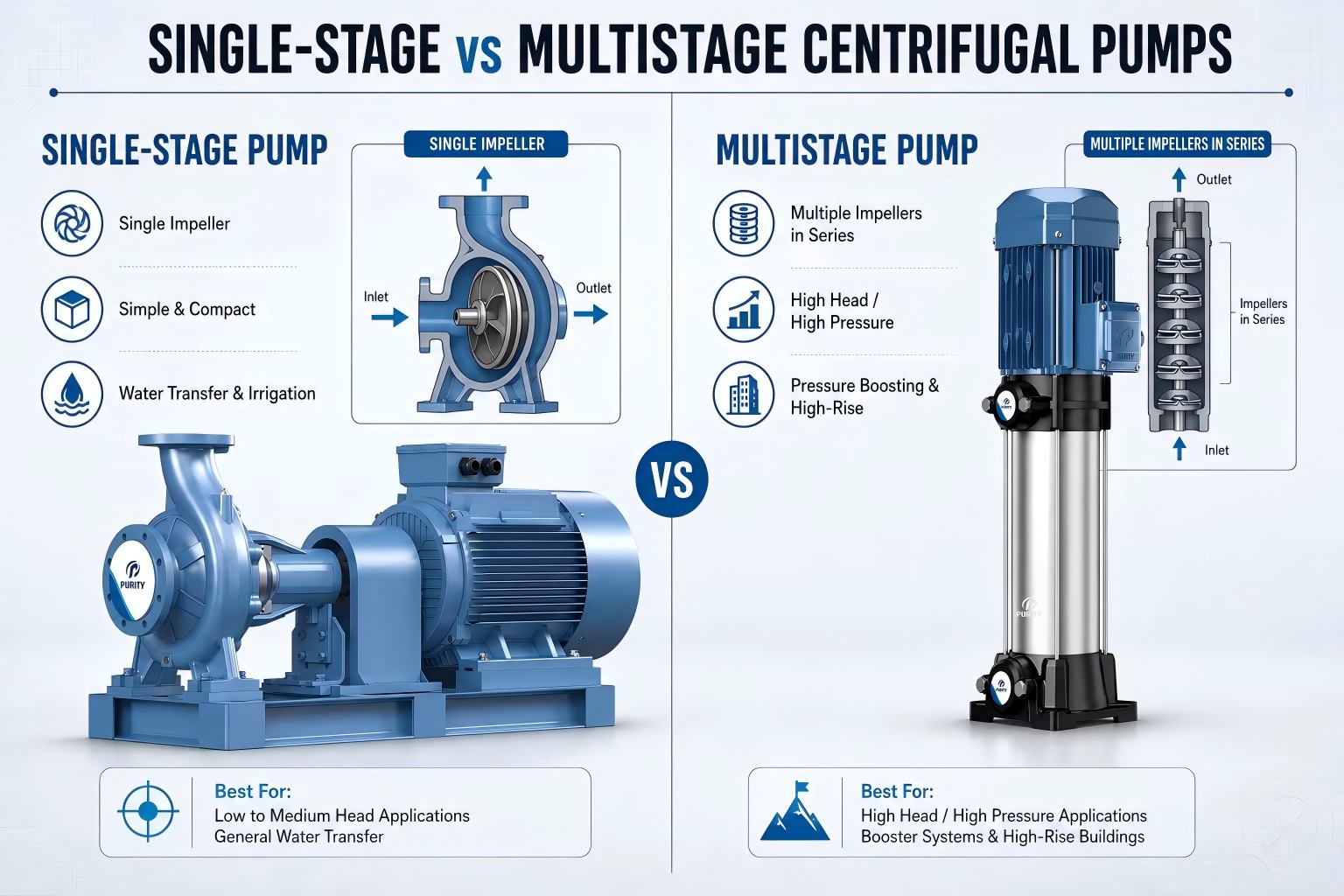
The main difference between single-stage and multistage pumps is the number of impellers. A single-stage pump uses one impeller, while a multistage pump uses two or more impellers arranged in series. This arrangement allows the pump to generate different pressure levels to suit specific applications.
A single-stage centrifugal pump has one impeller mounted on a rotating shaft. Its relatively simple structure makes it suitable for applications requiring moderate head and a wide range of flow rates.
Key features of single-stage pumps:
Impellers: One
Head: Depends on the pump design, speed, and impeller diameter
Applications: Irrigation, HVAC circulation, general water transfer, and drainage
Maintenance: Generally straightforward, with fewer internal components
Single-stage pumps are commonly used where high pressure is unnecessary. They are available in various configurations, including end-suction, inline, and self-priming designs.
For example, an end-suction centrifugal pump can provide water for industrial processes or irrigation systems. A single-stage jockey pump can also maintain pressure in a fire protection system, reducing unnecessary starts of the main fire pump.
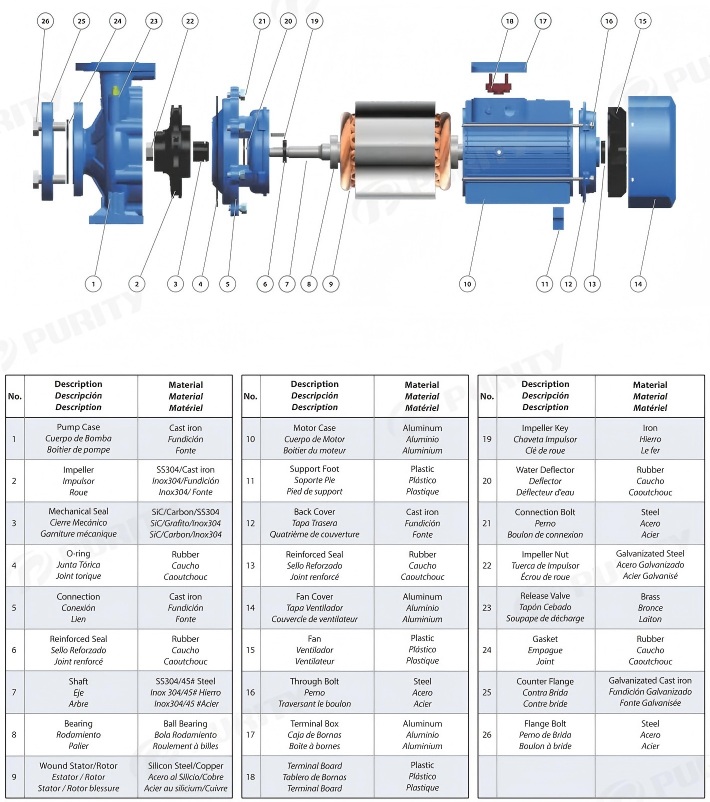
Picture|Purity PSM Single Stage Pump Assembly
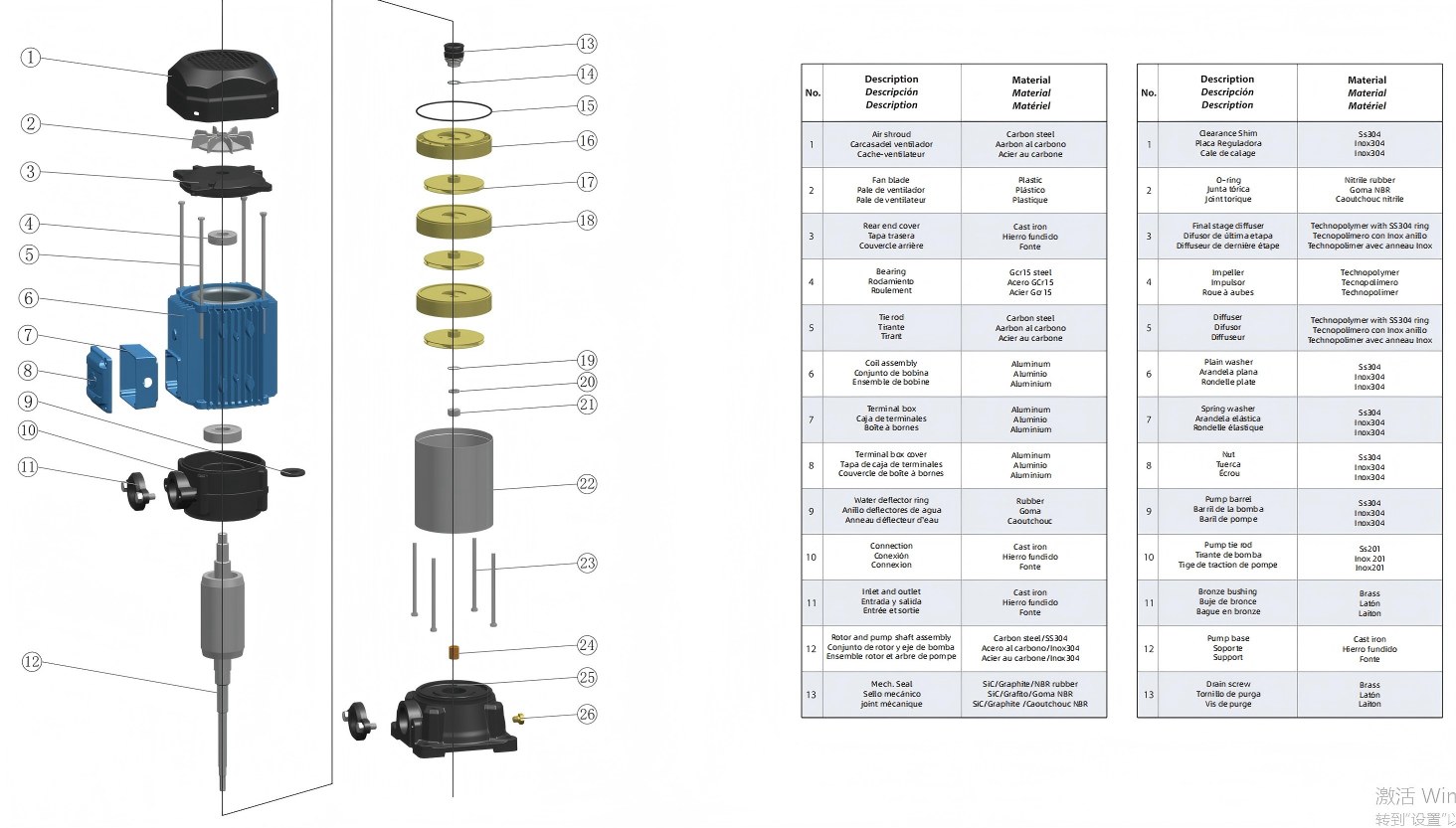
A multistage centrifugal pump contains two or more impellers connected in series. As liquid passes through each stage, additional energy is transferred to it, increasing the total pressure.
Key features of multistage pumps:
Impellers: Two or more
Head: Higher total head can be achieved by adding stages
Applications: High-rise buildings, boiler feed, pressure boosting, and industrial water supply
Maintenance: May require more specialized servicing due to its internal structure
At a given flow rate, the head produced by each stage contributes to the pump's total head. This makes multistage pumps suitable for applications requiring high discharge pressure or substantial vertical lift.
Vertical multistage pumps are particularly useful in buildings and industrial facilities where floor space is limited. Their compact design and multiple stages make them suitable for booster systems, water treatment, and other high-pressure applications.
|
Feature |
Single-Stage Pump |
Multistage Pump |
|
Impellers |
One |
Two or more |
|
Pressure capability |
Low to high, depending on design |
Suited to higher head requirements |
|
Flow rate |
Depends on model and duty point |
Depends on model and duty point |
|
Structure |
Generally simpler |
More complex |
|
Typical applications |
Irrigation, circulation, water transfer |
High-rise supply, pressure boosting, boiler feed |
|
Maintenance |
Usually simpler |
May require more specialized servicing |
Important: Neither pump type is automatically more efficient. Efficiency depends on the pump's operating point, hydraulic design, motor, and system requirements. A properly selected single-stage pump can be more efficient for a low-head application, while a multistage pump may be suitable for high-head duties.
Before selecting a pump, consider these four factors:
Required head: Choose a pump that meets the total dynamic head, including elevation, pressure requirements, and pipe losses.
Required flow: Match the pump's performance curve to the system's actual demand.
Installation space: Consider horizontal or vertical configurations, pipe connections, and maintenance clearance.
Operating costs: Evaluate efficiency at the expected duty point, energy consumption, and maintenance requirements.
For moderate-head water transfer, a single-stage pump may offer a straightforward solution. For high-rise water supply, boiler feed, or high-pressure boosting, a multistage pump may be more appropriate.
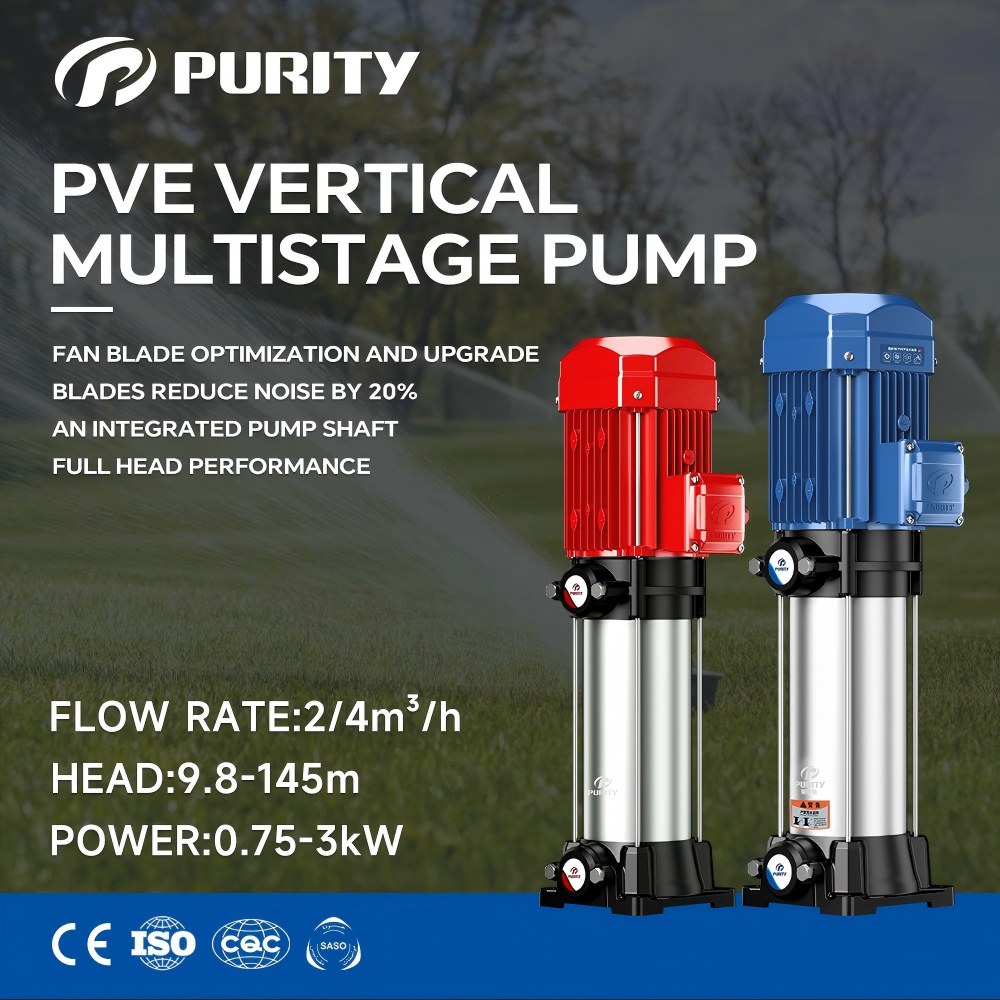
Purity's PVE vertical multistage pump is designed for applications requiring reliable pressure and compact installation. Its full-head operating design supports operation across a range of flow conditions within the specified performance range.
The PVE series is available with power ratings of 0.37–3 kW and heads of 18–115 m, making it suitable for selected water supply and pressure-boosting applications. Actual performance depends on the model and operating conditions.
The main difference between single-stage and multistage centrifugal pumps is their impeller arrangement and resulting head capability. Single-stage pumps use one impeller and suit many general water-transfer applications. Multistage pumps use multiple impellers in series to achieve higher total head.
The right choice depends on the required flow, head, operating conditions, and system design. Contact Purity to discuss your application and identify a suitable centrifugal pump solution.