PRODUCTS SEARCH
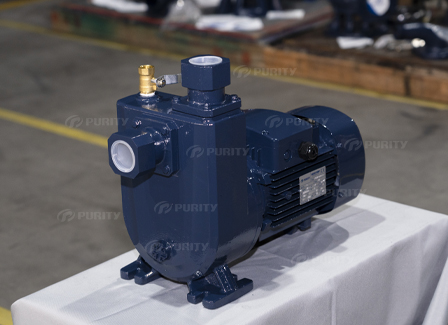
This makes self-priming pumps particularly useful for applications where the pump is installed above the liquid level, such as water supply, irrigation, drainage, wastewater transfer, and industrial fluid handling.
A self-priming pump is usually designed with a special pump casing that can retain a certain amount of liquid after the first priming operation. When the pump starts again, the retained liquid circulates inside the casing and mixes with the air in the suction line.
As the air is gradually removed, liquid enters the impeller area and fills the suction pipe. Once the suction system is filled with liquid, the pump returns to normal centrifugal operation.
Therefore, self priming does not mean that the pump never needs liquid. Most self-priming pumps require the casing to be filled during initial commissioning. Their main advantage is that subsequent startups can automatically restore suction without repeating the entire manual priming process.
The working process of a self priming centrifugal pump can be simplified as:
Retained liquid → impeller starts → air and liquid mix → air is removed → liquid recirculates → suction line fills with liquid → normal pumping begins.
The special casing of a self-priming centrifugal pump typically contains a liquid reservoir or separation chamber. After the initial prime, this chamber retains liquid when the pump stops.
When the pump restarts, the impeller circulates the retained liquid. The liquid mixes with air from the suction line, allowing the air to be discharged from the pump. As more air is removed, liquid gradually reaches the impeller and establishes continuous flow.
This explains the principle of centrifugal pump self priming: the pump does not simply “suck” water from below. Instead, it uses retained liquid and internal circulation to remove air and establish the conditions required for normal pumping.
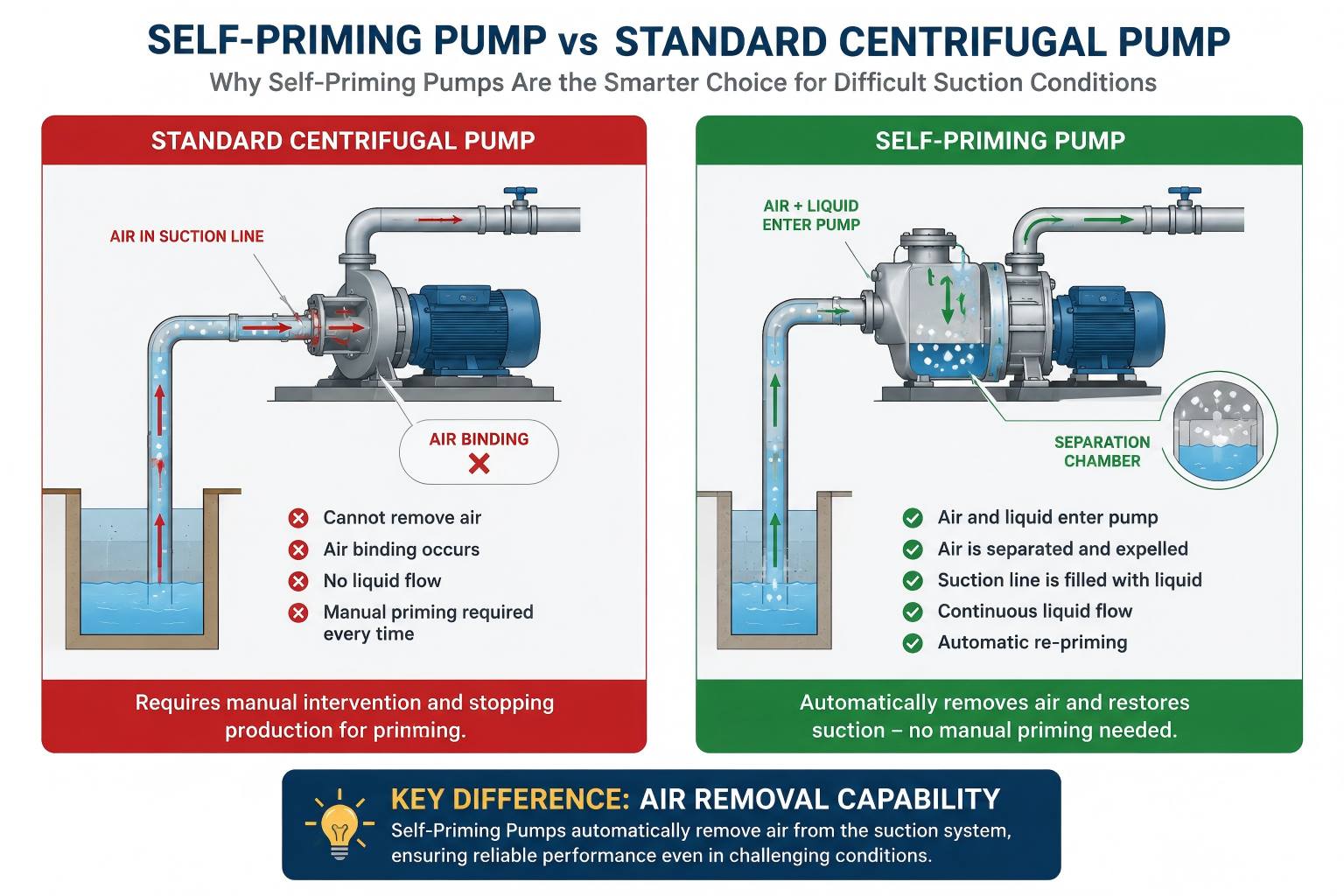
Picture|Standard Centrifugal Pump vs Self-Priming Pump
A standard centrifugal pump relies on a liquid-filled impeller to generate centrifugal force and develop pressure. If the pump casing and suction line contain a large amount of air, the impeller cannot efficiently transfer the fluid, which can cause air binding and prevent normal pumping.Traditional centrifugal pumps may therefore require:
· Manual priming
· A foot valve
· Flooded suction
· A permanently liquid-filled suction line
· An external vacuum or priming system
A self-priming design addresses this problem by retaining liquid inside the casing and using it to remove air during startup.
This makes self-priming pumps especially useful when the liquid source is below the pump, such as ponds, tanks, pits, or other low-level water sources.
The key difference between a self-priming centrifugal pump and a conventional centrifugal pump is its internal casing design.
A self-priming pump typically needs a liquid-retention or air-separation area to:
1. Retain liquid after shutdown.
2. Mix retained liquid with air during startup.
3. Remove air from the suction line.
4. Restore liquid flow to the impeller.
The reliability of a pump also depends on its materials and mechanical design.
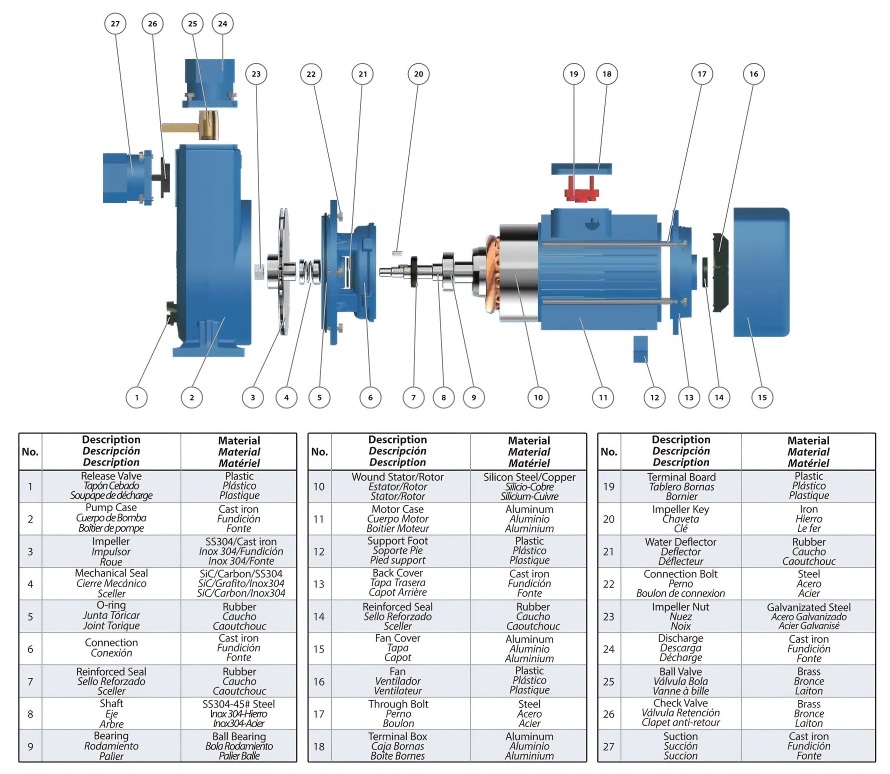
For example, the Purity PXZW self-priming centrifugal pump uses a 304 stainless steel welded shaft, which improves corrosion resistance and helps support long-term shaft reliability. Its threaded four-port inlet and outlet connection also simplifies installation in suitable piping configurations.
Under suitable conditions, many self-priming pumps can achieve a practical suction lift of approximately 6–8 meters. However, this should not be treated as a universal maximum.
Actual suction performance depends on:
· Vertical suction lift
· Suction pipe length and diameter
· Elbows and valves
· Strainers
· Friction losses
· Liquid temperature
· Installation altitude
· Vapor pressure
· NPSH conditions
· Changes in liquid level
Therefore, pump selection should always be based on the manufacturer's performance data and the actual system conditions.
Automatic re-priming: Reduces repeated manual priming.
Air-handling capability: Helps remove air from the suction line during startup.
Flexible installation: Suitable for many applications where the liquid level is below the pump.
Easy maintenance: Surface-mounted pumps are generally easier to inspect and service than submerged equipment.
Intermittent operation: Well suited to applications requiring frequent starting and stopping.
Self-priming pumps are not automatically better than conventional centrifugal pumps in every application. Their internal self-priming structure can result in lower efficiency compared with a similar standard centrifugal pump.
They also have limited suction lift, and even a small air leak in the suction line can make priming difficult. For fluids containing solids, the pump must be selected according to the impeller and casing design.
When selecting a self priming pump, consider more than suction lift:
1. Flow Rate: Determine the required operating and peak flow.
2. Total Head: Make sure the pump can meet the required system head.
3. Suction Lift: Measure the vertical distance between the lowest liquid level and the pump centerline.
4. Fluid Properties: Consider viscosity, temperature, corrosiveness, and chemical compatibility.
5. Solids Content: Check the allowable particle size if pumping wastewater or solids-containing liquids.
6. NPSH: Ensure that available NPSH exceeds required NPSH with an appropriate safety margin.
7. Priming Time: Consider suction pipe length and the required startup time.
8. Installation Conditions: Consider available space, piping layout, maintenance access, and indoor or outdoor installation.
Because of their ability to operate above the liquid source, self-priming pumps are commonly used for:
· Domestic and commercial water supply
· Agricultural irrigation
· Pond water transfer
· Wastewater transfer
· Construction and mine dewatering
· Industrial cooling
· Water treatment
· Equipment washing
· Tank and vessel transfer
· Pharmaceutical and chemical processes
The Purity PXZW self-priming centrifugal pump is designed for applications including domestic water supply, agricultural irrigation, environmental protection, construction, pharmaceutical processing, dyeing, brewing, power generation, electroplating, papermaking, industrial washing, and equipment cooling.
These applications share a common requirement: the liquid source may be located below the pump, making reliable self-priming capability important.
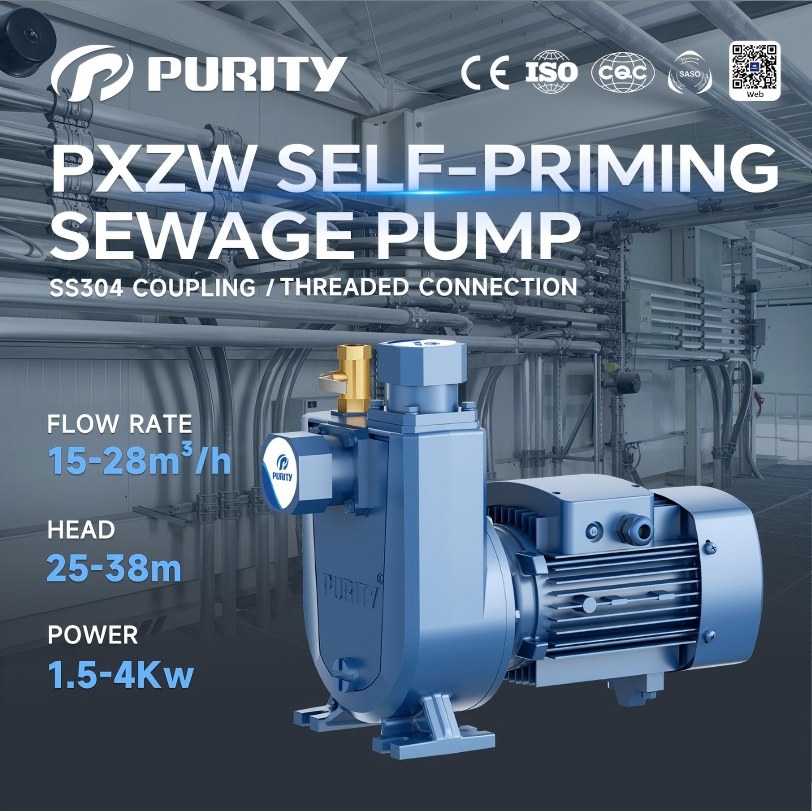
For a self-priming pump, performance is only one part of the equation. Materials, manufacturing quality, testing, and after-sales support also affect long-term reliability.
The Purity PXZW self-priming centrifugal water pump is CE certified and features a 304 stainless steel welded shaft for improved corrosion resistance. Its threaded four-port connection design also provides convenient installation for suitable systems.
As one of the experienced self priming centrifugal pump manufacturers, Purity Pump has more than 16 years of pump manufacturing experience and operates a 60,000 m² manufacturing facility.
Purity provides a range of pump solutions for water supply, irrigation, wastewater, fire protection, and industrial applications, with certifications including CE, ISO, and SASO.
A self priming pump uses retained liquid and internal circulation to remove air from the suction system and restore liquid flow automatically after the initial priming process.
Its ability to operate above the liquid source makes it a practical choice for water supply, irrigation, wastewater, drainage, dewatering, and industrial applications.
However, selecting the right pump requires more than looking at suction lift. Flow rate, total head, suction lift, fluid properties, solids content, NPSH, priming time, and installation conditions should all be evaluated.
For applications requiring a reliable self priming centrifugal pump, choosing the right design and manufacturer is essential for stable and efficient long-term operation.